c. 218 BCE – 350 CE
Kingdom of Kush
c. 1070 BCE – c. CE 350 / kingdom in Nubia (modern-day Sudan), northeast Africa
Date range and summary are drafted from Wikidata pending a scholarly-source verification pass — treat as approximate, not settled fact, until re-sourced from academic historians/archaeologists.
Overview
The Kingdom of Kush was one of the great civilizations of ancient northeastern Africa, flourishing for more than a thousand years along the Nile Valley in what is now northern Sudan and southern Egypt. Its roots reach back to Nabta Playa, a Nubian settlement dated to around 7500 BCE whose megaliths form one of the world’s earliest known astronomical devices, predating Stonehenge by nearly two millennia. Out of that deep Nubian tradition of organized, planned settlement grew a state with its own language, its own script, and a complex economy built on trade, industry, and archery — a civilization long overshadowed by its northern neighbor Egypt but, as archaeology has since shown, every bit its equal in sophistication.
Kerma and the Rise of an Independent Power
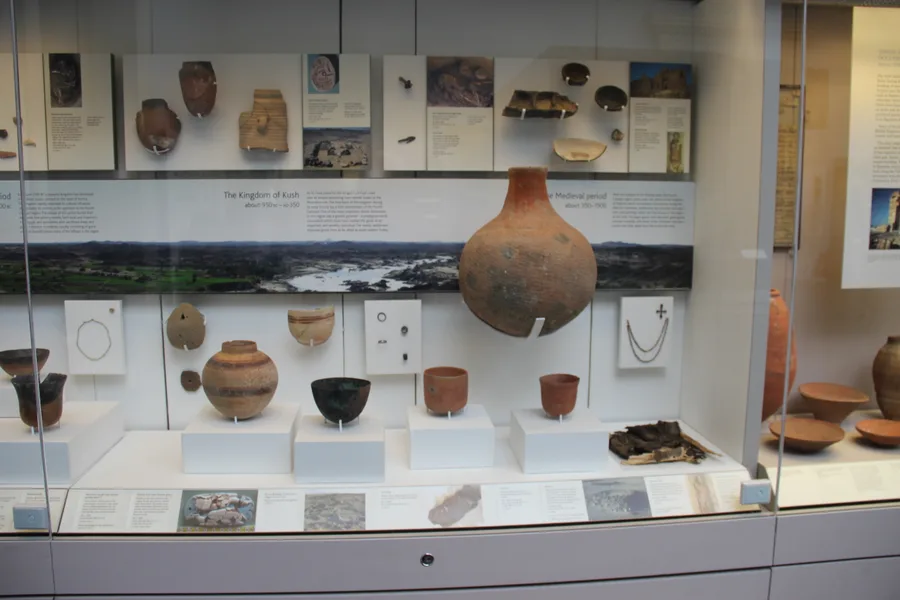
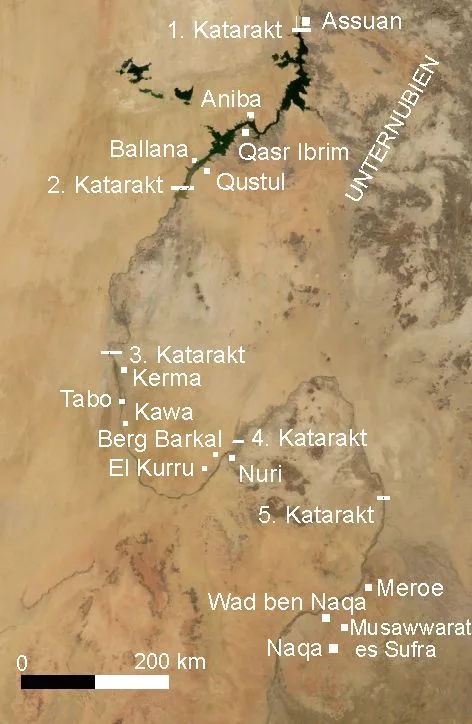
Kush’s first major expression of power was the city-state of Kerma, which dominated the Nile Valley between the first and fourth cataracts — a territory as large as Egypt itself — from roughly 2450 to 1450 BCE. Egyptian sources gave this Nubian power the name “Kush,” likely derived from the indigenous ethnonym “Kasu.” For centuries the two civilizations traded, intermarried among royalty, and fought, until much of Nubia came under Egyptian rule during Egypt’s New Kingdom period. When Egypt itself fractured in the Late Bronze Age collapse, the Kushites reasserted independence, rebuilding their kingdom around the city of Napata. Kushite culture absorbed some Egyptian religious practice, including the worship of Amun, but Egyptian artists of the era still took care to depict the Kushites as visibly distinct in dress, appearance, and custom — a civilization in dialogue with Egypt, not a copy of it.
The Kushite Pharaohs Who Ruled Egypt
Kush’s most remarkable achievement came in the 8th century BCE, when King Kashta peacefully assumed the throne of Upper Egypt and installed his daughter Amenirdis as divine adoratrice of Amun at Thebes, one of the most powerful religious offices in the Egyptian world. His successor, Piye, completed the conquest of Lower Egypt and founded the Twenty-fifth Dynasty — Kushite monarchs who ruled the whole of Egypt as pharaohs for more than a century, commissioning temples and monuments across the Nile Valley, until the Assyrian kings Esarhaddon and Ashurbanipal drove them back south in the mid-7th century BCE. It remains one of the clearest examples in the ancient world of a sub-Saharan African power governing Egypt on its own terms rather than the reverse.
Meroë and Lasting Legacy
After losing Egypt, Kush relocated its capital to Meroë, a city the ancient Greeks knew as the seat of “Aethiopia,” and continued as a major regional power for centuries more — at one point pushing back a 600-year Ptolemaic and Roman presence in northern Nubia under King Yesebokheamani. Meroitic Kush is distinguished by a written script still not fully deciphered today, a mastery of iron production, and, notably, unusually high levels of female political participation, including queens who ruled in their own right. The kingdom’s decline in the 4th century CE, amid climate pressure and the rise of the Kingdom of Aksum, gave way to the successor states of Nobatia, Makuria, and Alodia, which carried Kushite Nubian identity forward. Kush’s pyramids at Meroë — more numerous than Egypt’s — and its centuries as an independent African power stand as a direct rebuttal to any account of ancient Africa that starts and ends with Egypt.